The "measure" field of the variable settings configures the scale or level of measurement. The concept of measurement scales is credited to Stanley S. Stevens, who proposed that the concepts of nominal, ordinal, interval, and ratio scales. The measurement scale setting can be useful when choosing the analyses at a later point in time. PSPP can use this variable information to guide users towards the analyses that are the most appropriate.
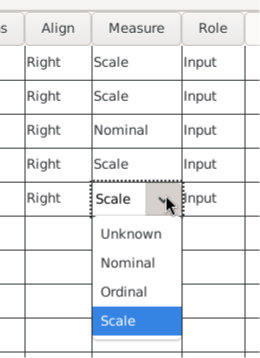
PSPP has four possible scale settings.
Nominal scales represent categories. Our Sex variable is a category (male, female, or non-binary), so it was set to nominal.
Ordinal scales are used for numbers that represent rankings that may not have a uniform interval size. An example would be ranking people in a sample based on how tall they are. For example, the tallest person would be #1, the next tallest would be #2, and so on. Stanley Stevens argued that many psychological variables have ordinal scales (e.g., 1 to 5 ratings of approval), but not everyone agrees with this idea.
The Scale setting is for data that have a consistent unit size, such as seconds, grams, and meters. The Scale setting represents both interval scales (equally sized units but no zero point) and ratio scales (equally sized units and a zero point). It is not clear why interval scales and ratio scales are treated the same by the software.
Home | Start | Variables | Data | Descriptive | Relationship | Inferential | Effect size | Advanced | Video
This work is licensed under a Creative Commons Attribution 4.0 International License that allows sharing, adapting, and remixing.