PSPP has a special label feature for groups called value labels. It's for assigning names to groups that might be coded with numbers.
Clicking in the value label field for a variable will create a dialog box with the entry options. The screenshot shows an example of the dialog raised by clicking in the value label field.
For group membership, the coding scheme can be entered as the value and the value label. Click "add" to enter the scheme.
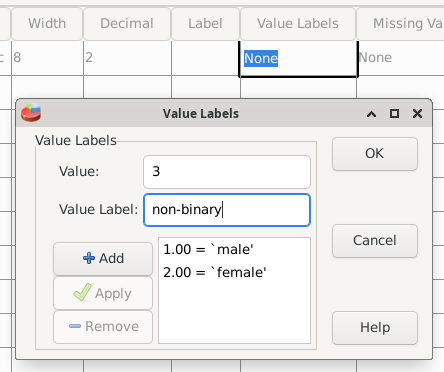
In the example, note that the type of the sex variable is set to be numeric, not words like "male", "female", or "non-binary." In statistics, categories like male/female/non-binary or married/single/divorced are often represented by numbers rather than words. For example, males could be coded as 1, females could be coded as 2, and non-binary coded as 3. These codes sometimes represent experimental groups, such as experimental group vs. control group.
This practice of using numbers to represent groups may seem odd to new statisticians, but it is common and very useful. This is sometimes called "dummy coding", with the word dummy possible being used because the values do not represent a numerical measurement (nominal scaled data).
Taking the time to document our value labels will be useful for our outputs. The labels like "male" or "female" will be included in our outputs rather than the less informative codes "1" and "2". This documentation will be valuable for keeping track of what the codes mean if we refer back to this analysis at a later point in time. A third advantage is that manual data entry will be much faster by entering a group code number rather than spelling out a full name for each group.
Value labels are only needed for variables that hold a numerical code representing group membership. It can be left blank when variables hold other information.
Home | Start | Variables | Data | Descriptive | Relationship | Inferential | Effect size | Advanced | Video
This work is licensed under a Creative Commons Attribution 4.0 International License that allows sharing, adapting, and remixing.